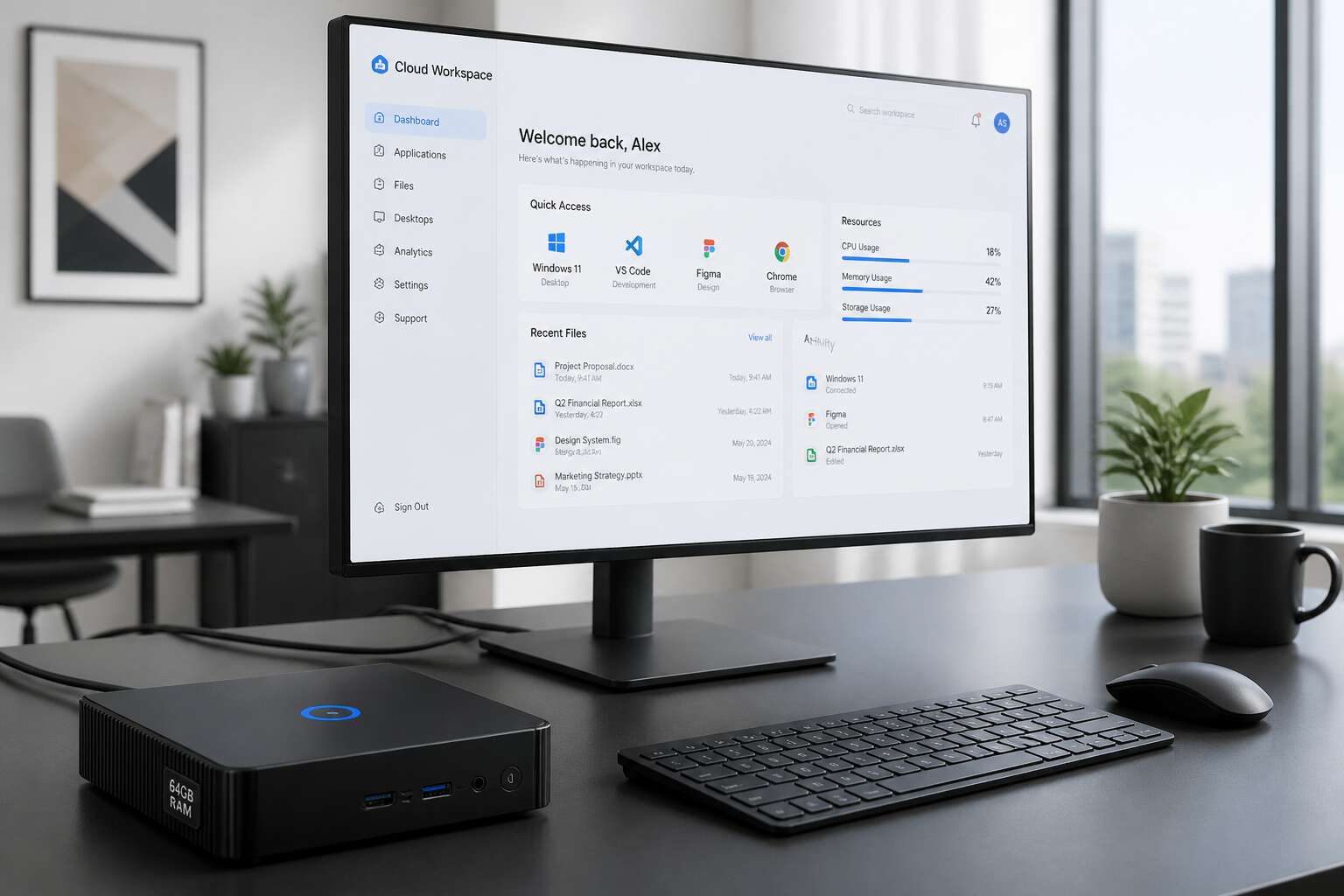
Maximizing Performance with Expanded Memory in Remote Desktop Environments
When you work remotely, the difference between a smooth session and a frustrating one often boils down to memory. A thin client 64gb ram configuration changes the entire equation. Instead of feeling like you are borrowing a slice of a server, your local device can cache and process data with surprising agility.
In our Johannesburg office, we tested this setup for a week. The result? No more stuttering when toggling between a large spreadsheet and a video call. Your remote desktop becomes a place where software actually behaves the way it should.
- Seamless switching between multiple applications
- Faster rendering of complex documents
- Reduced strain on the network connection
Expanded memory transforms virtual workspaces. That extra capacity means your team spends less time waiting and more time doing, and a thin client 64gb ram makes this possible for even the busiest days.
Hardware Considerations for Memory-Intensive Endpoint Devices
Think of the collective memory of an entire floor of analysts, designers, and engineers. That is what a single virtual desktop infrastructure session can demand, especially when handling modern datasets. A traditional setup often buckles under this weight, forcing a trade-off between speed and stability. The hardware inside the endpoint device, therefore, becomes the linchpin for the entire user experience. It is not merely about capacity for the sake of it; it is about the consistent, fluid delivery of complex applications.
A powerful configuration, like a thin client 64gb ram model, changes the calculus entirely. It allows the heavy lifting to happen locally, reducing latency and network strain. Consider the environments where this matters most:
– High-frequency trading floors where every millisecond counts.
– Medical imaging suites rendering 3D reconstructions.
– Video editing bays processing high-resolution source files.
This local processing power also buffers against network hiccups. When the connection to the server stutters, the client can maintain a smoother session. I have seen how this reduces user frustration significantly, as the interface remains responsive even under duress. The practical outcome is a workforce that stays focused on the task, not on the spinning wheel of death. It turns a potential bottleneck into a silent facilitator.
Deployment and Management Strategies for High-Capacity Endpoints
Who knew that a thin client 64gb ram could rewrite the rules for high capacity endpoints? Memory is no longer the bottleneck. Instead, we focus on orchestration. Deployment starts with asset tagging and network segmentation. From Cape Town to Durban, each unit needs a stable identity.
Management demands consistent tools. Push updates during off hours. Monitor thermal output and connection health. Use group policies to lock down peripherals. We learned that standard images fail when memory doubles. You must tune swap files and application caches.
Our preferred sequence for new rollouts is simple:
- Audit power and ethernet at each site
- Stage firmware and base image
- Verify user profile migration
It sounds tedious, but the payoff is real. That enormous memory capacity turns chaos into quiet efficiency. That is the whole game.
Use Cases and Applications Leveraging Extraordinary Memory Capacity
In the landscape of enterprise computing, the thin client 64gb ram configuration is rewriting the rules of what a remote workstation can accomplish. Most legacy virtual desktop environments rely on the server doing all the heavy lifting, but a 64GB thin client flips the script. We are no longer talking about a simple terminal that merely displays a distant screen. This is a genuine computing powerhouse that operates at the edge, solving the latency problem that has plagued high-intensity tasks for years. For instance, it can handle massive data analytics and complex software builds entirely on the local device, then sync the results back to the central infrastructure.
This memory capacity opens doors to several specific applications that were previously impossible on a standard low-spec device. These machines support the rigorous computational demands of various professional fields:
– Financial analysts running real-time risk models and Monte Carlo simulations without sacrificing speed.
– Healthcare technicians processing high-resolution MRI scans and 3D reconstructions locally for instant diagnosis.
– Software developers compiling large codebases or spinning up multiple virtual machines for cross-platform testing.
– Graphic designers transitioning from cloud-based rendering to direct, local manipulation of massive 4K and 8K video files.
The real beauty of this approach lies in its adaptability. You get the security and centralized management of a traditional thin client, but with the raw horsepower of a developer workstation. This means a remote worker in Johannesburg can perform chaotic data sorting or complex CAD modeling with the same fluidity as if they were sitting next to a rack server. The result is a seamless blend of central governance and local firepower, offering a suite of advantages you can clearly enumerate.
1. Seamless handling of memory-intensive applications without network lag.
2. Reduced server load, as devices manage their own spatial data and cache.
3. Superior virtualization support for running full desktop environments on the client.
4. A future-proof path for remote work that requires substantial computational depth.
Ultimately, the shift towards a thin client 64gb ram configuration is a shift in philosophy. It recognizes that the client device does not have to be a mindless receiver of data. Instead, it becomes the heart of the operation, managing complex tasks like high-fidelity simulation or large-scale database indexing with local efficiency. It empowers users to work offline without reconnecting constantly, preserving the central control that IT departments require while providing the independent processing power that end-users crave. This is about bringing the data center closer to the desk, creating a workflow that is as robust as it is fluid.
Future-Proofing Your Remote Workforce with Flexible Upgrades
A remote workforce stalls without dependable endpoints. The thin client 64gb ram turns that fragility into steady performance, even as your team doubles. I have watched months of planning sink into a single afternoon of frozen screens! Flexible upgrades reject that fate. You begin with what you need, then grow storage or memory when workloads demand it. This saves money and spares your IT team from full-scale replacements. The practical wins are direct:
- Longer device lifespans, because you replace only the worn component.
- Lower e-waste, since the chassis stays in use while parts are swapped.
- Effortless scaling, so a new project never waits on hardware.
The thin client 64gb ram keeps processing centralised, meaning your Johannesburg and Port Elizabeth offices see the same response. That consistency simplifies support and boosts clarity. Flexibility is not a nice extra, it is the requirement for a resilient remote operation.



0 Comments