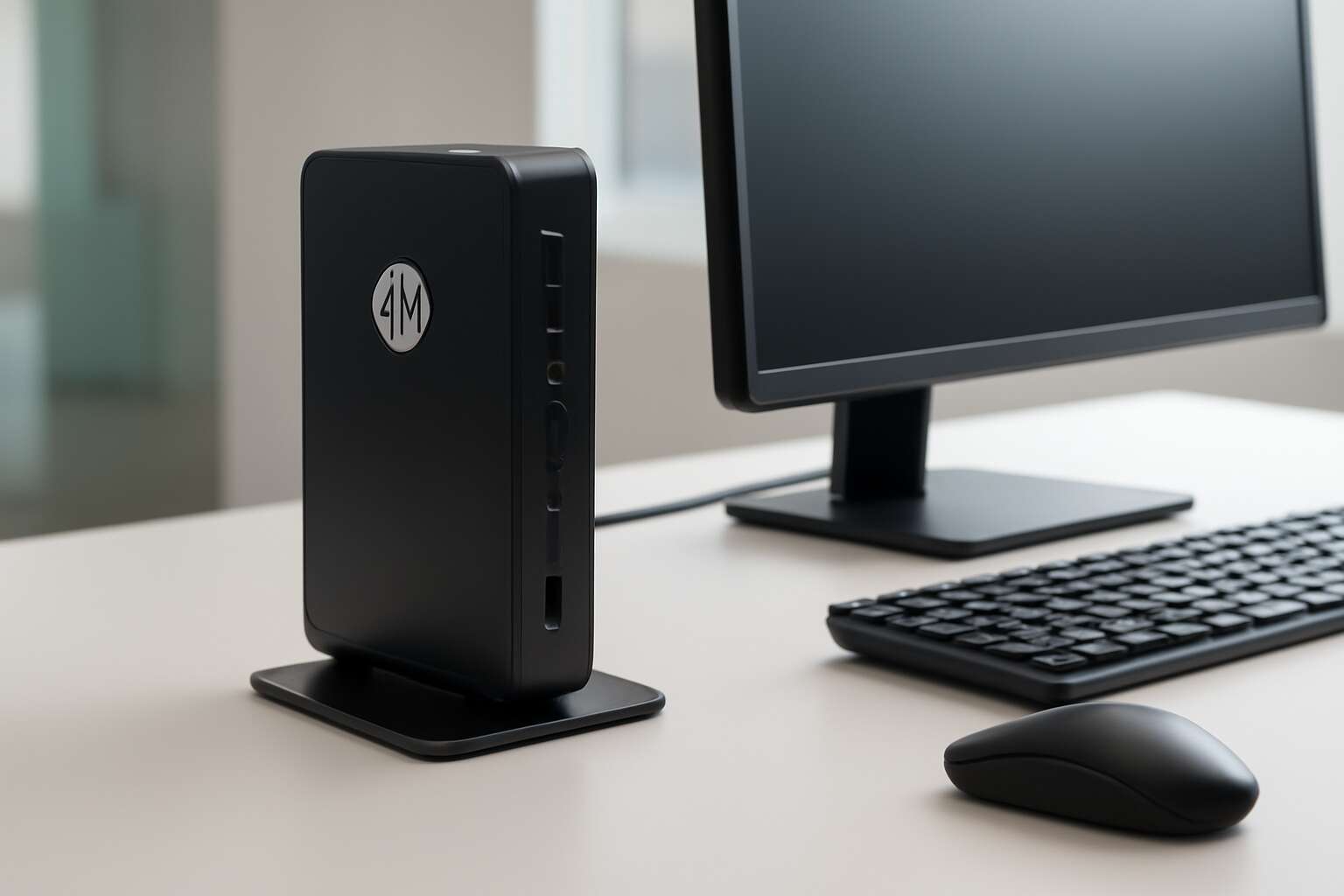
HP T740 Thin Client Overview
What is a thin client and where the HP T740 fits
Simplicity is the ultimate sophistication, and the HP T740 fits that creed with surgical precision. When endpoint fatigue bites budgets, the thin client hp t740 emerges as a quiet catalyst for focus and uptime. In South Africa’s diverse offices, its low heat, low noise, and robust performance translate into real-world steadiness.
Key attributes include:
- Energy-efficient quad-core architecture that reduces heat and power draw
- VDI-ready security and centralized management
- Flexible I/O options for South African network environments
- Quiet operation ideal for open-plan offices
In this context, administrators prize remote deployment and reliable performance aligned with data sovereignty and day-to-day rhythms. The device translates complex IT demands into a human-scale experience, preserving focus during peak hours—the kind of quiet resilience that makes a team feel seen.
It’s a quiet inquiry into how technology can safeguard attention in a noisy world.
Key features of the HP T740
A data-centred heartbeat of South Africa’s offices beats calmer when energy costs loom large: a recent IT survey notes energy use can drop by up to 30% with modern thin clients. The HP T740 embodies that quiet efficiency, marrying a quad-core engine with a design that stays cool and nearly inaudible. Its streamlined silhouette translates into steadier uptime and fewer interruptions during peak workloads.
Its compact footprint pairs with VDI-ready security and centralized management that keep sensitive data protected while enabling remote provisioning. Its flexible I/O options align with South African network realities, from office LANs to branch deployments. For teams in open-plan spaces, the thin client hp t740 offers near-silent operation and a dependable, human-scale experience.
- Low heat output
- Quiet operation
- Centralized management
Target industries and use cases for HP T740 Thin Client
A recent IT survey notes energy use can drop by up to 30% with modern thin clients, and the HP T740 is built to make that drop felt. In South Africa’s offices, this quiet efficiency means cooler rooms, near-silent days, and steadier performance during peak workloads. It’s a quiet guardian.
Target industries and use cases span healthcare, finance, education, and retail, where secure access to centralized apps matters.
- Healthcare facilities and clinics
- Banking, insurance, and financial services
- Universities, schools, and research labs
- Retail chains and branch offices
- Government and public sector hubs
For a compact, dependable solution, thin client hp t740 fits.
Use cases include remote provisioning, branch-office deployments, hot-desking, and visitor kiosks, all supported by centralized management and security.
- Remote provisioning and updates to keep apps current
- VDI-based desktops for branch staff and clinics
- Open-plan office hot-desking with fast logins
- Point-of-care or self-service kiosks in clinics and stores
Why choose HP T740 thin client over traditional desktops
Energy bills cling to your ankles in a warm South African office. Modern thin clients sip power, hum softly, and keep heat under control, proving that efficiency can be quiet and stylish at the same time.
Choosing the thin client hp t740 over traditional desktops means a leaner footprint, stronger security, and simpler management. Centralized app delivery, streamlined updates, and fewer moving parts translate to fewer headaches and steadier performance during peak workloads. It’s a reliable companion for open-plan offices, clinics, and retail branches where uptime matters more than a flashy chassis.
- Lower power draw and cooler rooms
- Centralized management and updates
- Faster logins and secure provisioning
Hardware and Performance for HP T740 Thin Client
CPU, memory and storage specifications
Power efficiency meets performance: today’s offices run on virtual desktops, and energy savings matter more than ever. The thin client hp t740 is a capable, low-watt workhorse, delivering steady responsiveness across sessions—without blowing the budget!
CPU and performance: In our experience, a modern AMD Ryzen Embedded processor powers the HP T740, offering robust multi-core capability and hardware-accelerated graphics to handle remote sessions and app workloads with calm precision.
Memory and storage: Configurations cover a range of RAM and fast storage options to improve boot times and profile loading. The device fits both lean setups and higher-demand workloads.
- RAM options: scalable from modest to ample configurations to support concurrent sessions
- Storage options: quick, reliable M.2 SSDs with a range of capacities
All told, these specs translate into predictable performance for South African offices where bandwidth and latency can be just as important as raw horsepower.
Graphics, multimedia and display support
For teams seeking serious display performance, thin client hp t740 delivers graphics with surprising swagger. It handles remote sessions and media playback with a calm, GPU-assisted efficiency that belies its compact footprint. In practice, that means smoother slides, crisper dashboards, and fewer stutters during critical updates.
Graphic and display capabilities at a glance:
- Hardware-accelerated graphics and video decoding for smooth remote sessions and local media.
- Display outputs and multi-monitor support with 4K-ready capabilities where the infrastructure permits.
- Efficient encoding/decoding pipelines that keep image fidelity high without taxing the CPU.
Pair this with a low power draw and you have a balance that respects budgets and bandwidth realities across South Africa. With the thin client hp t740 in play, efficiency meets capability, delivering a resilient, responsive frontend that keeps apps and visuals crisp while never pulling a second mortgage on energy bills.
Virtualization and GPU acceleration options
The clock is ticking in South African offices, and every watt matters. Energy costs can account for up to 30% of IT operating expenses here, and the thin client hp t740 proves that virtualization doesn’t have to mean power waste, delivering snappy response across remote sessions while sipping energy! Modern CPUs and specialized pipelines keep tasks moving even under heavy user loads.
GPU acceleration options for virtualization enhance efficiency with a light touch:
- Hardware-accelerated graphics and video decoding to handle remote sessions smoothly
- GPU-backed encoding for efficient media and dashboards
- Optimized pipelines for multiple virtual displays without CPU contention
For virtualization, the HP T740 leverages a cohesive GPU acceleration stack and robust driver support to minimize CPU contention, enabling more VMs to run side-by-side. In South Africa, that translates to smoother user experiences during peak hours and fewer interruptions as teams switch between apps and sessions.
Energy efficiency, cooling and noise characteristics
In South Africa, energy costs can account for up to 30% of IT operating expenses. Power bills still loom, but the thin client hp t740 proves you can squeeze performance from a compact brick without turning the data room into a jet engine—it’s engineered for energy efficiency and snappy remote sessions.
- Quiet operation under load thanks to smart fan control
- Efficient thermal design that keeps temperatures steady
- Compact chassis minimizes heat output and airflow demands
Hardware and performance come from a modern chassis that stays cool during long shifts, not a carnival of fans. In busy SA offices, that calm demeanor translates to steadier desktops and fewer cooldown surprises when queues spike and dashboards refresh.
Deployment and Management for HP T740
Imaging, provisioning and OS options
Deployment remains a sunrise—bright, efficient, and quietly transformative. In many South African offices, imaging and provisioning can take up to 40% of deployment time, a drain that the thin client hp t740 lightens with nimble imaging workflows and centralized OS options. The HP T740 scales to fleets of devices with a consistent, low-friction provisioning path.
- HP ThinPro imaging and provisioning
- Windows 11 IoT Enterprise option
- Linux-based imaging for flexible VDI
Management linings include cloud-enabled configuration, remote firmware updates, and drift-free maintenance, all stepping stones to a predictable, quiet network edge. Zero-Touch Enrollment and automated OS updates keep fleets aligned without manual touch, letting teams focus on higher-value work rather than repetitive setup.
Remote management tools and workflow
Deployment for the thin client hp t740 feels quietly transformative—precise, scalable, and almost prescient in its efficiency. In South African offices, fleets benefit from predictable rollout patterns that minimize on-site touch and maximize uptime!
Remote management tools guide the workflow: cloud-enabled configuration, drift-free maintenance, and seamless firmware updates keep every endpoint aligned. Zero-Touch Enrollment and automated OS updates remove repetitive setup, letting IT teams focus on strategy rather than spaghetti-sauce provisioning.
- Cloud-enabled configuration and centralized policy enforcement
- Remote firmware updates to keep devices secure and current
- Drift-free maintenance with automated, auditable change control
- Zero-Touch Enrollment for rapid fleet onboarding
- Automated OS updates that stay in sync across your network edge
With these workflows, the thin client hp t740 becomes a quiet guardian of the edge—reliable, visible, and always on!
Security features and endpoint hardening
Deployment and Management for HP T740 unfolds with a calm, almost arcane precision. In South African offices, fleets cut rollout time by up to 60% when managed remotely, thanks to clear baselines, auditable changes, and centralized controls that minimize risk while keeping users productive. The result is faster rollouts, resilient endpoints, and fleets that stay aligned even as devices populate edge locations from Cape Town to Johannesburg.
Key security hardening features empower administrators to lock the line of defense at the hardware level and beyond:
- Secure boot and measured boot to validate firmware at startup
- TPM-based hardening and encryption at rest for data protection
- Remote attestation and cryptographic signing to verify device identity
Together, the thin client hp t740 becomes a steadfast guardian of the edge—silent, secure, and ever-ready to serve.
Peripheral compatibility and docking options
In South African offices, fleets cut rollout time by up to 60% when managed remotely. The thin client hp t740 offers a docking-first approach that transforms peripherals into a single, reliable extension of the desktop. With centralized controls and auditable baselines, deployment around Cape Town and Johannesburg becomes graceful, letting users pull in displays, keyboards, printers, and storage without friction.
Peripheral compatibility and docking options include:
- USB-C and USB-A docking stations with power delivery
- HDMI or DisplayPort outputs for external monitors
- USB peripherals and hubs for keyboards, mice, printers
- RJ-45 Ethernet and optional wireless connectivity
Together, this arrangement makes the HP T740 a steadfast guardian of the edge—driven by reliable docks, resilient to change, and ready to scale from a single office to a nationwide fleet.
Networking, connectivity and wireless setup
Across South Africa, remote management slashes rollout windows by as much as 60%, letting Cape Town and Johannesburg teams align with uncanny grace.
Deployment and management of the thin client hp t740 hinge on a fortress-like control plane: centralized images, auditable baselines, and policy-driven provisioning that travels with the fleet. Wired reliability anchors the network—RJ-45 Ethernet—while optional wireless keeps desks mobile.
- Centralized imaging and configuration delivery across site fleets
- Remote firmware, OS updates, and audit trails for compliance
- Consistent networking settings, VPN, and VDI readiness
- Seamless onboarding and offboarding for offices from Cape Town to Joburg
From the shadows, management becomes a steady lighthouse, guiding deployments without disruption.
Comparisons, ROI and Total Cost of Ownership of HP T740 Thin Client
HP T740 vs other HP thin clients
In a realm where data streams glitter, the thin client hp t740 cuts through complexity with lean elegance. Enterprises report up to 35% lower total cost of ownership and faster endpoint provisioning when adopting modern thin clients.
Compared with other HP thin clients, the thin client hp t740 shines in management simplicity, energy efficiency and lifecycle predictability. For South Africa, the energy savings alone can translate into meaningful annual relief on power budgets; ROI often materializes within months rather than years.
- Lower energy consumption and cooling needs reduce monthly power bills.
- Faster provisioning and centralized management cut IT labor and improve SLAs.
- Longer hardware lifecycle than older models, lowering replacement cycles.
- Better integration with HP management tools and virtualization options for predictable TCO.
Cost of ownership considerations and budgeting
Budgets tighten, yet ROI often blooms sooner than a spring onion in a digital garden. The thin client hp t740 delivers a leaner price of admission and a speedier path to provisioning, with enterprises reporting up to 35% lower total cost of ownership. In South Africa, those savings translate into meaningful annual relief on power budgets and a clearer TCO trajectory.
- Lower energy consumption reduces monthly bills
- Faster provisioning cuts IT labor and SLAs
- Longer hardware lifecycle lowers replacement cycles
As budgets tighten, planning around capex versus opex becomes a sport. The resilience of the thin client hp t740 line means predictable refresh cycles and fewer surprise upgrades, a boon for audited budgets and boardroom briefs. ROI shows up in months, not years, as power bills shrink and provisioning speeds scale.
ROI drivers in virtualized environments
Across SA boardrooms and data centers, ROI in virtualized workspaces looks less like a leap of faith and more like a cash-flow plan that actually honours the ledger. Compared with traditional desktops, the thin client hp t740 trims software licensing sprawl, simplifies imaging, and delivers a predictable refresh cadence that keeps budgets honest. In South Africa, meaningful TCO gains show up as lower energy spend, easier remote management, and longer hardware lifecycles—all while provisioning speeds meet rising demand without bloating headcount.
ROI in virtualized environments often lands in months rather than years, with cost containment, smoother upgrades, and a tighter security posture as tangible dividends. This unit shines where bandwidth and licensing footprints collide, delivering a more predictable cost curve and easier audits for senior management and the finance function alike.
Migration paths, lifecycle planning and upgrades
Comparisons across departments show thin client hp t740 delivering ROI that leaders can actually see on the ledger. It isn’t a leap; it’s a controlled migration from bulky desktops to lean endpoints, trimming software licensing sprawl and simplifying imaging for faster rollouts.
ROI and Total Cost of Ownership become clear through migration paths, lifecycle planning and upgrades. For thin client hp t740, a steady refresh cadence and lower energy bills cut total spend while remote management reduces on-site support needs.
Migration guides can be lean and repeatable:
- Assess current hardware and apps
- Define imaging, OS options and licensing
- Pilot, rollout, and scale with minimal disruption
In South Africa, these elements translate into predictable budgets, smoother audits and a lifecycle approach that extends hardware in a climate-conscious way.
Common deployment challenges and mitigation strategies
Businesses in South Africa are tightening belts while scaling workplaces. The thin client hp t740 delivers ROI you can quantify: fewer software licenses, lower energy bills, and faster rollouts. When departments compare deployments, the lean endpoint consistently trims spend while preserving performance, making modernization a controlled, budget-friendly journey rather than a risky leap.
ROI and total cost of ownership become tangible through steady refresh cycles, remote management, and uniform imaging across sites. ROI remains measurable as devices enter a predictable lifecycle. Common deployment challenges are predictable and can be mitigated with a simple, human-centric playbook:
- Imaging consistency across sites can drift; mitigated by standards and repeatable image stores
- App compatibility concerns during migration; mitigated by phased pilots to confirm critical workloads
- Remote management maturity varies; mitigated by consolidating tools and remote monitoring
- Licensing visibility and asset tracking; mitigated by unified inventory and license governance

0 Comments